Simple Sheet Mode: The Easy Bridge from Beginner to Real Sheet Music
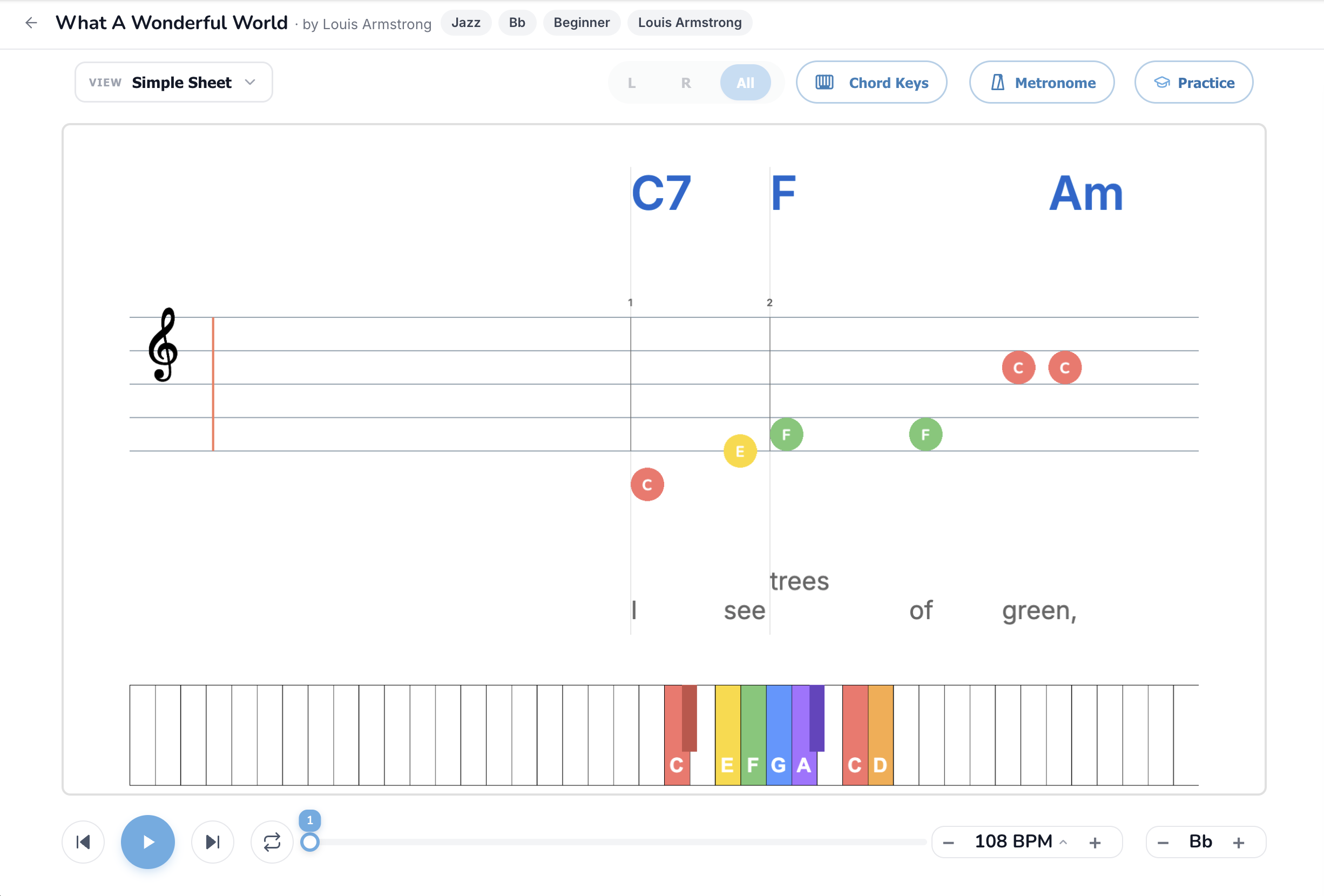
Single-stave right-hand melody with chord labels and lyrics. The fastest on-ramp from Beginner mode to full grand-staff sheet music reading.
Simple Sheet is the mode that turns "I'd love to read sheet music someday" into "I read sheet music." It strips real notation down to one stave and just the melody, then keeps the colored note heads as training wheels so you're never stranded. It's the gentlest possible on-ramp from Beginner mode to full Sheet Music mode.
For an overview of all eight modes side by side, see the player modes guide.
What you're actually looking at
A clean treble-clef stave with just the right-hand melody on it. Three more layers sit alongside the stave:
Crucially, Simple Sheet uses real rhythm notation: quarter notes, half notes, eighth notes, ties, rests. This is where you start training your eyes to recognise rhythm symbols rather than relying on bar lengths. The colored note heads make pitch easy, but rhythm you have to read.
The full feature set, button by button
View dropdown
Simple Sheet is sandwiched between Beginner (no notation) and Sheet Music (full notation). Most players cycle through these three modes as their reading improves.
L / R / All pill
Cosmetic in Simple Sheet because only the right hand is shown. Keep on All.
Chord Keys toggle
The chord symbols above the stave are your left-hand cheat sheet. Press just the root note of each chord (the F in "Fmaj7") and you've got a passable arrangement immediately. Turn off if you want pure melody practice.
Metronome
Essential. Simple Sheet is the first mode in the learning path where rhythm notation matters, and you'll build wobbly rhythm without a click.
Practice button
Connect a MIDI keyboard for live grading. Simple Sheet works well with both Performance mode (grade as you play) and Waiting mode (pause at each note). See How to Practice with Your Real Piano.
BPM control
Critical. The whole point of Simple Sheet is to give you time to read each note before you play it. Start at 50-60%, build up over weeks.
Song Key transposer
A great way to recycle a song you already know. Play the song in C, then transpose to D, then to F. Each transposition is a fresh reading exercise.
Click-to-seek
Click any bar number to set a loop. Drill the four bars of the chorus until they're clean, then loop the verse, then put them together.
How to read Simple Sheet without intimidation
The recipe that works for ex-Beginner-mode players:
How rhythm reading works in Simple Sheet
You see four basic note shapes in Simple Sheet:
When two eighth notes are next to each other, the flags often merge into a beam (a horizontal bar across the tops of the stems). That's still two eighth notes, just drawn more efficiently.
A dot to the right of any note adds half its value. A dotted quarter note = 1.5 beats. A dotted half note = 3 beats.
A tie is a curved line connecting two notes of the same pitch, meaning hold the first one for the combined duration. A quarter note tied to a quarter note = 2 beats held.
That's 90% of the rhythm reading you'll ever need.
Common mistakes
Songs worth trying in Simple Sheet mode
Easy reading:
Medium reading:
Stretch goals:
When you've outgrown Simple Sheet
When the colored note heads start to feel redundant, you're ready for Sheet Music mode. The jump from Simple Sheet to Sheet Music adds the bass clef stave and full two-hand notation, which feels overwhelming at first but actually unlocks reading any piano score ever printed.
If you want to keep things simple but add more body to your arrangements, try Bars Sheet mode instead, two hands, but rhythm-by-bar-length rather than rhythm-by-notation.
Or read the full mode comparison for the wide-angle view.
TL;DR
Simple Sheet is the bridge from Beginner mode to full Sheet Music. One stave, right hand only, real rhythm notation, colored note heads as training wheels, chord symbols above. Practice with metronome on at 50-60% BPM, ramp up over weeks. Add left-hand root notes from the chord symbols once the right hand is automatic. Browse the easy songs and start reading today.
Ready to start playing?
Put it into practice with thousands of color-coded, slow-down-able songs, free in your browser.