Get this sheet
PDF sheets + MIDI
Yours to keep
PDF sheets and the MIDI file. Yours to keep.
Instant download · no account needed
Or every song with Premium, from $4.99/moUp next

Play Crying on your own piano
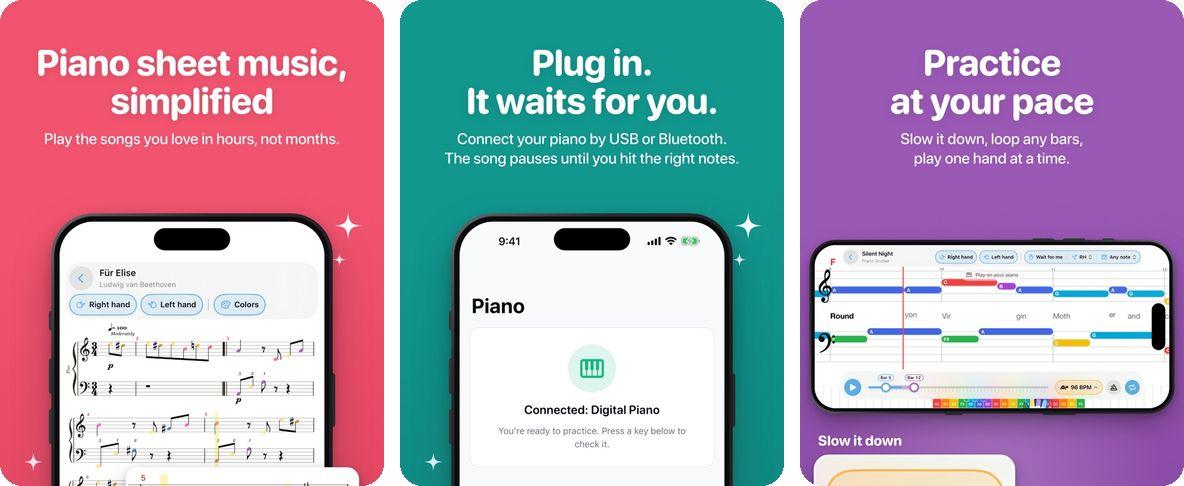
Plug in your piano by USB or Bluetooth. The song waits for you until you hit the right notes. Slow it down, loop any bars, play one hand at a time.
- 1Get the app. Free on the App Store.
- 2Sign in. Use the same email you unlock songs with.
- 3Connect your keyboard. By USB or Bluetooth, and play along.
Crying — Classic Piano Sheet Music
About “Crying”
Read "Crying" by Roy Orbison in classic piano notation — both hands, real chords + notes, in the published key of C. Engraved server-side from the publisher MusicXML; click any note to jump there as the score follows along at 110 BPM.
54 people have learned this song
Lyrics
I was all right
was for a while;
I could smile for a while,
I but I saw you last night; you held my (C)hand so tight, as you (F)stopped to say, “Hel (Fm)lo.”
(G9)Oh, you (C)wished me well; you (G7)could n’t tell
that I’d been (C)cry ing (Em)o ver you, (C)cry ing (Em)o ver you.
When (F)you
said, “So (G7)long;”
left me (F)stand ing
all a (G7)lone,
a lone and (C)cry ing,
(C)cry ing,
(F)cry ing,
(Fm)cry ing.
It’s hard to (C)un
der stand,
but the (G7)touch
of your hand
can start me (C)cry ing.
I thought that right
was o ver you
but it’s true, so a while,
I love you e you ven more you than I (C)did be fore, but dar (F)ling, what can I (Fm)do?
(G9)For you (C)don’t love me I’ll (G7)al ways be
I’d been (C)cry ing (Em)o ver you, (C)cry ing (Em)o ver you.
Yes, (F)now
you’re “So (G7)gone
and from (F)this ing
mo ment (G7)on
a I’ll be (C)cry ing,
(C)cry ing,
(F)cry ing,
(Fm)cry ing.
It’s Yeah, to (C)cry
der ing,
but the (G7)cry
of your ing
can o ver (C)cry ing.
I thought that (C)you.
Teacher’s notes
This arrangement is a great way to get comfortable with chromatic voice leading — small, one-note shifts between chords that create big emotional swells.
Your biggest focus should be the C to C augmented move: all you're doing is raising the G up a half step to G♯, but it has to sound smooth, not jarring, so keep your hand relaxed and let that one finger glide.
The same idea applies when F major melts into F minor — just lower the A to A♭.
Practice those two transitions slowly, hands together, until they feel automatic.
Your left hand plays an octave bass pattern throughout, which is straightforward at 110 BPM, but watch that you don't rush it during the G7 and G9 sections where the melody gets busier.
I'd suggest looping the verse progression at around 80 BPM first, then gradually bring it up to tempo once the chord shapes sit in your fingers without looking.
A little sustain pedal on each chord change will help capture the song's aching, sustained quality — just be sure to release cleanly so nothing muddies together.
This is the piece that'll make chromatic chord shifts feel like second nature.
Questions about this song (13)
- Is this the same engraved sheet music a piano teacher would print for "Crying"?
- Yes — the score is rendered server-side from the publisher MusicXML using Verovio (the same engine RISM and OpenScore use). Standard piano notation, treble + bass staves, real chord symbols, key signature C. Print-quality and identical to what you'd see in a printed piano book.
- What key is "Crying" by Roy Orbison played in?
- Crying is arranged in the key of C on Super Simple Piano. You can transpose to any other key live in the player.
- What's the tempo (BPM) of "Crying"?
- The arrangement plays at 110 BPM. Use the speed control (10-200%) to practice slower or play faster.
- Is "Crying" easy to play on piano?
- Yes — this is one of our beginner-friendly arrangements with simplified chords and color-coded notes.
- Can I download sheet music for "Crying"?
- Yes — registered users can download PDF sheet music, plus MIDI and MusicXML files for use in other notation software.
- Who composed "Crying"?
- "Crying" was originally performed by Roy Orbison. The Super Simple Piano arrangement is simplified for beginner-to-intermediate players.
- What chords are used in "Crying"?
- This arrangement uses 7 chords: C, Caug, Em, F, Fm, G7, G9.
- What other songs by Roy Orbison can I play here?
- Try "OH, PRETTY WOMAN", "Oh, Pretty Woman", "YOU GOT IT". All are in our player with color-coded notes; pick the one matching your level.
- Is this the same notation a piano teacher would hand me?
- Yes — "Crying" is rendered at engraver quality (the Verovio engine, the same toolkit RISM and OpenScore editions use) from the original publisher MusicXML. You get standard piano notation: treble + bass clefs, key signature C, time signature, beams, dynamics — everything a printed sheet music book would have. Great for piano students learning to read music properly.
- What's the difference between Sheet Music and the other modes here?
- Sheet Music is the "classic" view — the one your piano teacher uses. Other modes (Beginner, Fall Down, Simple Sheet, Lead Sheet) trade real notation for color-coded notes and falling shapes to help absolute beginners. Use Sheet Music once you're ready to read both hands at once from real notation.
- Can I practice from this view at my own pace?
- Yes — slow the tempo from 110 BPM down (or up) without changing the pitch. The score scrolls in time and the currently playing note is highlighted, so you can drill a tough bar at half speed and bump it up once it feels comfortable.
- Why can I click a note in the score?
- Every notehead is interactive. Click and the audio jumps to that moment so you can drill a specific phrase or bar instead of replaying from the top. The currently playing note is highlighted as the music advances so your eye never loses its place.
- Can I download the sheet music as a PDF?
- Yes — Sheet Music PDF is one of the download formats for this song. The engraved score prints page-perfect on A4 / Letter so you can practice from paper as well as on screen.
Other versions of Crying
Other arrangements of Crying
Pick a learning view.